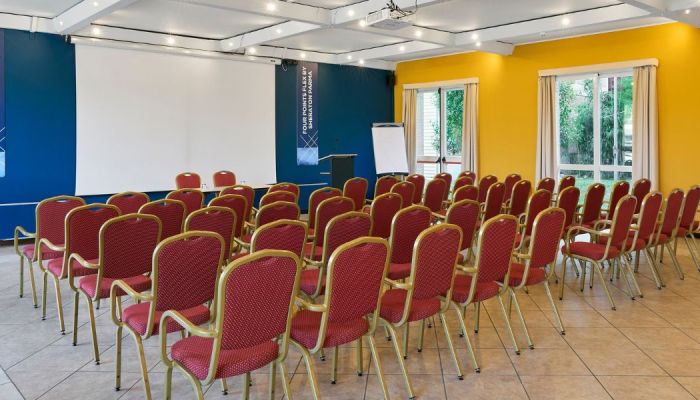
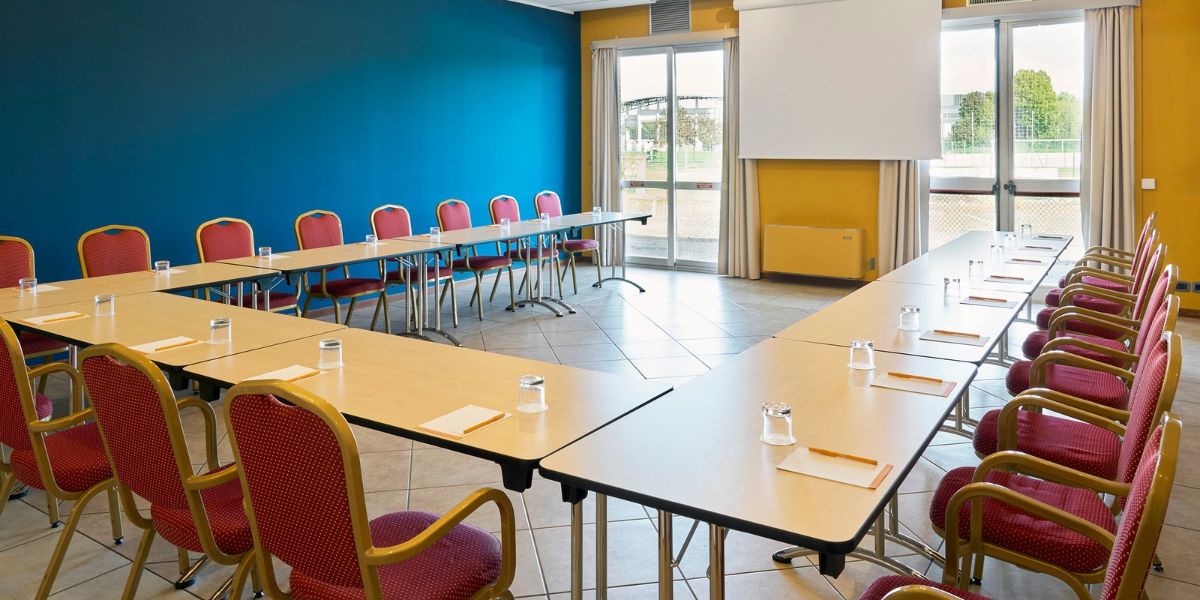
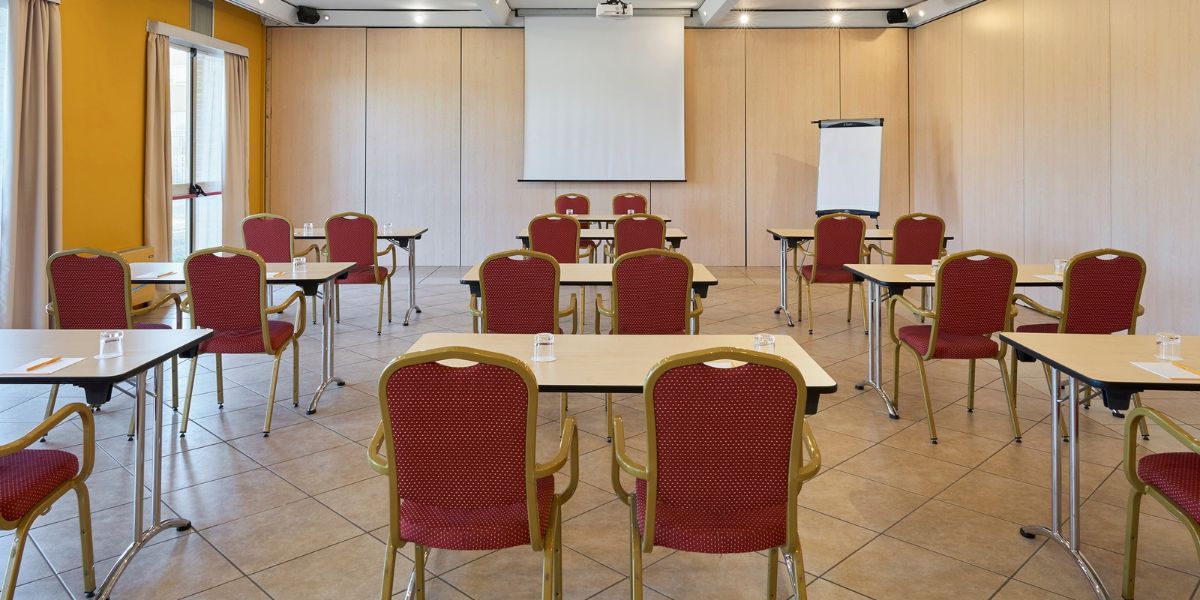
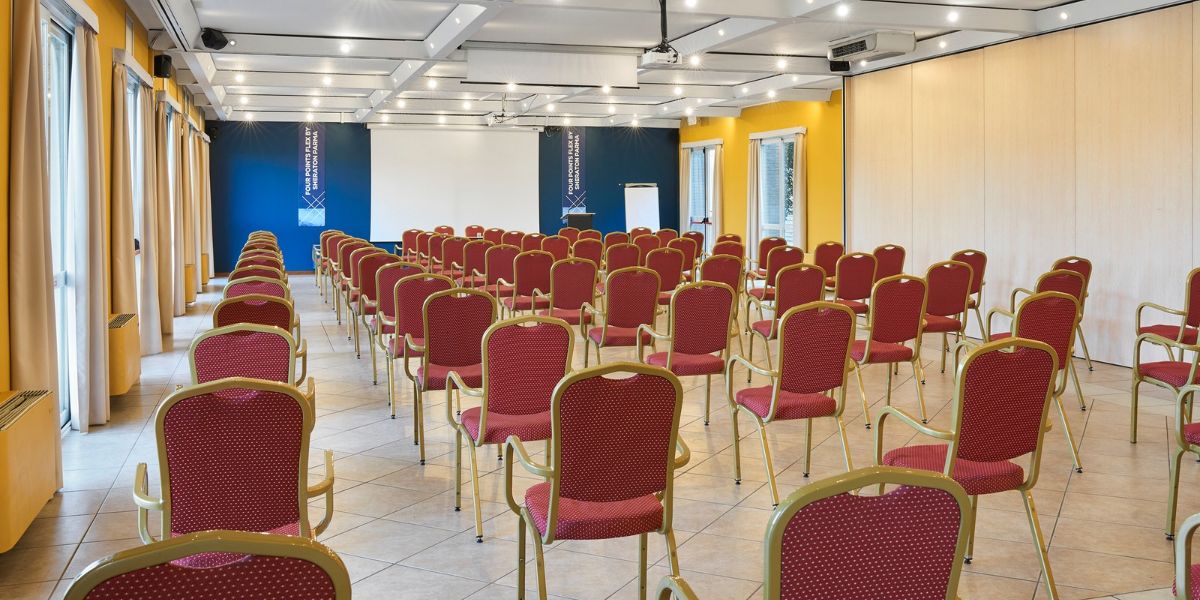
An elegant 4-star hotel just a stone's throw from the historic centre, the hotel has classic furnishings with marble floors and paintings on the walls [...]
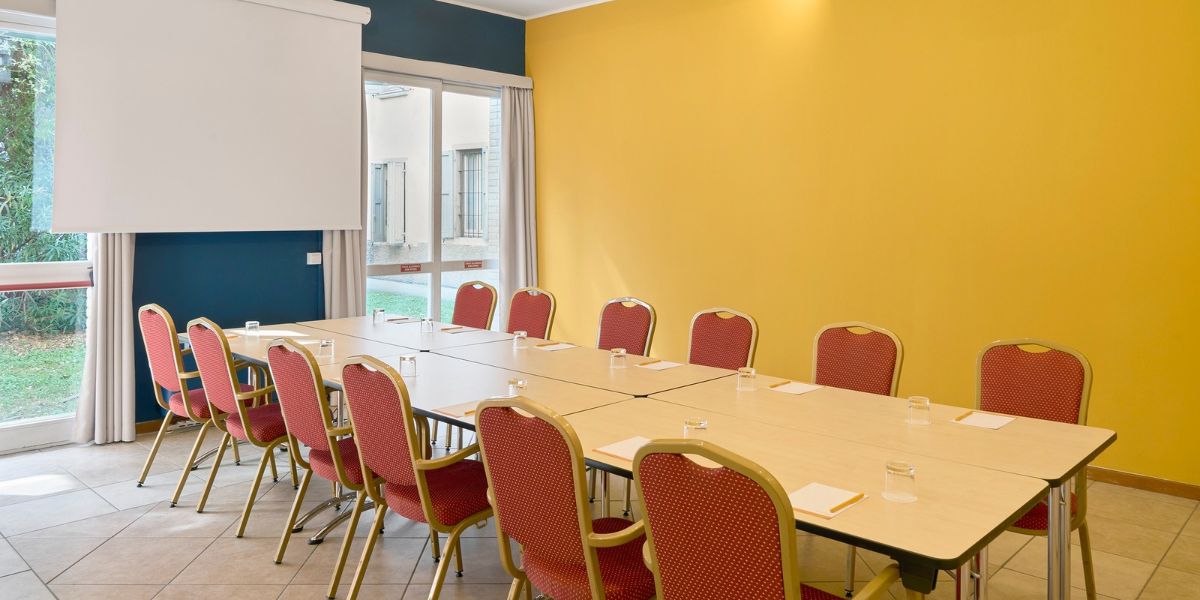
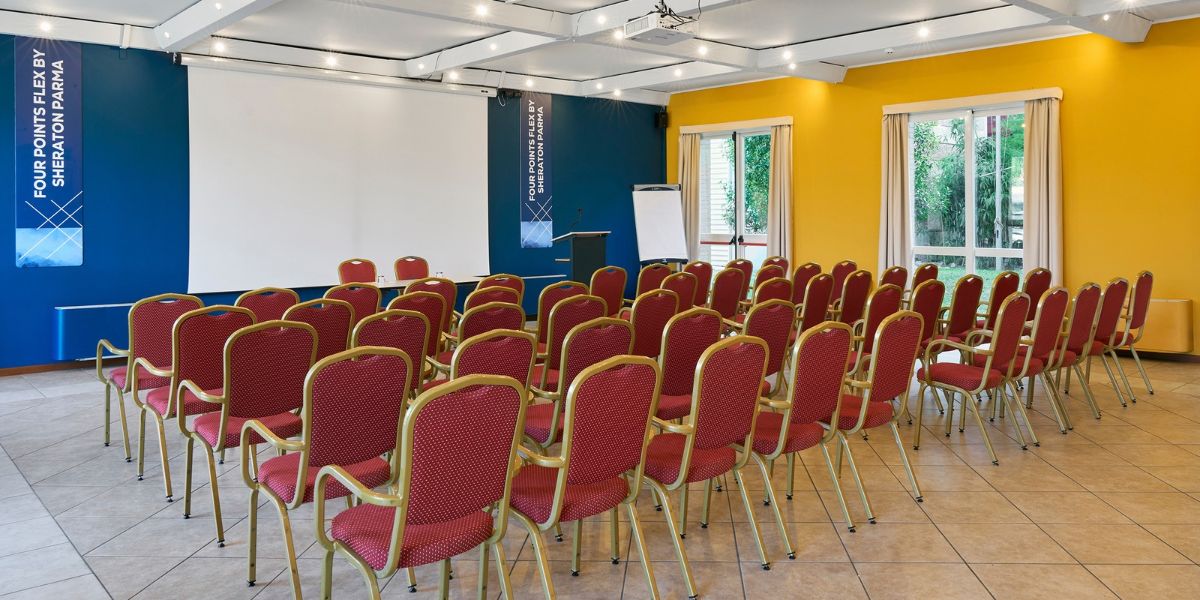
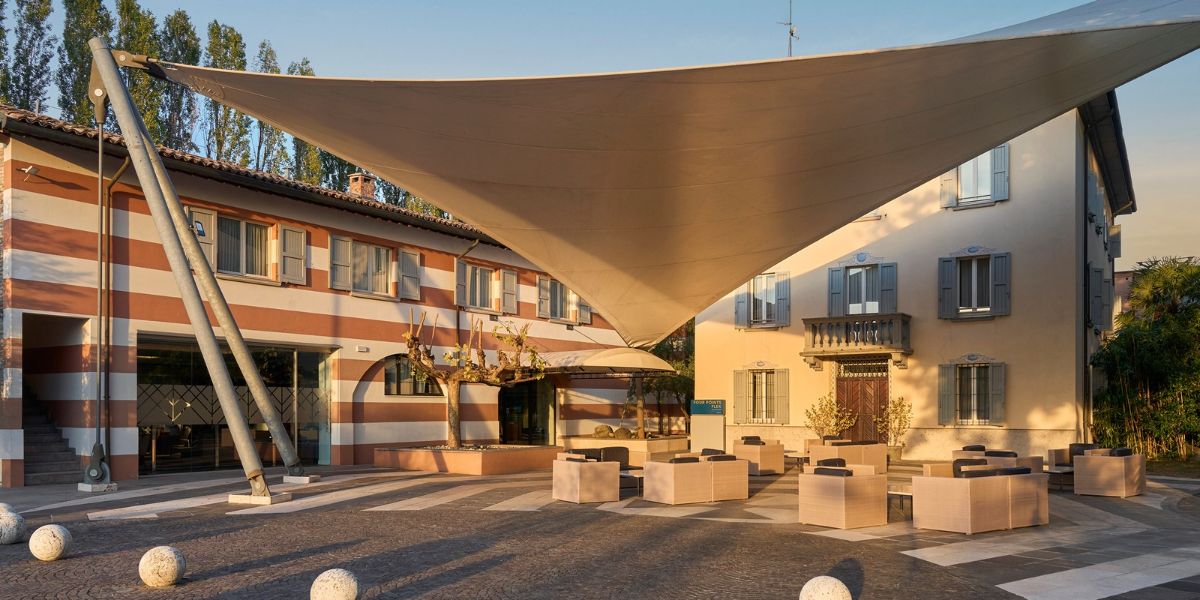
The Four Points Flex by Sheraton Parma is nestled in the peaceful countryside of Parma, just minutes from the city's charming historic center. Thanks to [...]
The Bedonia Episcopal Seminary features rooms for conferences, seminars, cultural gatherings, and study days.The facility also includes exhibition spaces for temporary displays, a room suitable [...]
Elegant 3-star Superior property, located about a five-minute walk from the historic center and very close to the train station. It has 53 rooms and [...]
The NH Parma hotel is part of a gleaming new complex designed by renowned Spanish architect, Oriol Bohigas. Hotel 4* is located in close proximity [...]
Immersed in the Parma countryside, just ten minutes by car from the heart of the city. Available in three fascinating rooms, bathed in natural light [...]
A refined multifunctional structure capable of hosting shows, conventions, congresses and gala dinners thanks to its scenic features. The modularity of the space and the [...]
The Hotel is an elegant and functional four-star hotel, an ideal location for conferences and meetings, in fact there are 6 meeting rooms, the largest [...]
The 4-star hotel, a pillar of the city's history, is a renowned hotel where modernity and tradition blend with elegance and passion.Its elegant hall with [...]
The profound redevelopment and valorisation intervention of the monumental complex of San Paolo has been underway since 2015 and, following the conclusion of the works, [...]
The museum headquarters of the Magnani Rocca Foundation in the villa of Corte di Mamiano di Traversetolo houses the prestigious collection of Luigi Magnani (1906-1984), [...]
Located on the northern side of Piazza Garibaldi, it unites, in the long façade of classical lines, two buildings of thirteenth-century origins. The Baroque tower, [...]
Modern and elegant 4-star hotel located 150 meters from the train station and the historic center.Inside, there is a fitness area, a seasonal outdoor swimming [...]
It is the largest labyrinth in Europe. conceived by the publisher, bibliophile, designer and collector Franco Maria Ricci and inaugurated in May 2015.The event spaces [...]
Opened in June 2018, after a careful two-year conservative restoration, APE Parma Museo, thanks to its large museum spaces spread over two floors, the elegant [...]
Paganini Congressi is the operating brand of the Paganini Consortium, founded in January 2015 on the initiative of the two main musical institutions of the [...]
The Teatro Regio, in addition to being one of the most renowned temples of opera music, also offers the possibility of hosting conferences, meetings and [...]
The Casa della Musica Sector is equipped with rooms that can be used for multiple functions ranging from music production to the organization of conferences/meetings, [...]
Four years after his last Italian creation and following the Golden Lion for Lifetime Achievement awarded by the Venice Biennale in 2023, the artist returns to Italy to inhabit and reinvent the spaces of two of the city’s most iconic cultural complexes: the Complesso Monumentale di San Paolo and the Ospedale Vecchio, which are thus being reopened to the public.
Both promoted by the Municipality of Parma, curated and produced by Alessandro Albertini (Influxus) in collaboration with Dominic Norman-Taylor, Juliana Consigli, and Martin Harrison (Lumen London), “My Light Years” is supported by the Cariparma Foundation, which shares with the Department of Culture the importance of the powerful role of art in supporting and developing the region. SEED, meanwhile, ranked first in terms of scores and amount of funding received in the ranking of projects submitted for the PAC2025 public call promoted by the Directorate-General for Contemporary Creativity of the Ministry of Culture.
A true icon of international contemporary culture, Brian Peter George St. John le Baptiste de la Salle Eno is one of the most significant artists of our time. Born in Woodbridge in 1948, he graduated from the Winchester School of Art at the University of Southampton in 1969. The father of ambient music and a pioneer of many other musical genres, Eno has collaborated with some of the most important artists of our time, contributing significantly to their success: Roxy Music (of which he was a member from 1971 to 1973), David Byrne, Talking Heads, Devo, Peter Gabriel, Ultravox, Paul Simon, Laurie Anderson, Grace Jones, U2, and Coldplay. Between 1977 and 1979, his artistic partnership with David Bowie gave rise to the historic Berlin trilogy: Low, Heroes, and Lodger. He composed and created the startup sound for the Windows 95 operating system for Microsoft. He has exhibited his work worldwide (from his participation in the Venice Biennale to the gigantic projection of his 77 Million Paintings on the sails of the Sydney Opera House) and has experimented with a wide range of expressive forms, becoming a pioneer of generative art. He is a founding member of the Long Now Foundation, Earth Percent, and Hard Art, a board member of Client Earth, a patron of Videre Est Credere, and an advisor to DiEM25 (Democracy in Europe Movement 2025). Considered one of the most influential artists and producers in the world, he is also internationally recognized for his significant production of artistic installations. A formidable traverser of languages, eras, and fashions, he creates multisensory environments through the use of technologies that today offer a kaleidoscopic three-dimensional concreteness to what he himself, in the 1970s, already envisioned with lucid vision. An intermedial modeler of light and sound, between colorful abstraction of alien forms and the search for new dimensions, he acts like a sculptor capable of generating digital creatures with natural sensitivity and delicacy. Starting from the idea of art as an expressive form capable of communicating with the surrounding environment and the viewer, he employs different media to blend music and the visual arts, creating veritable “soundscapes” in which the viewer is immersed. Using speakers, lights, and constantly moving images, he creates a combinatorial game of infinite variations of shapes and sounds, where not everything is always as it seems and everything changes imperceptibly, as in life, randomly and inexorably.
Art project
SEED
“Installation for Giardini di São Paulo” is a site-specific audio installation composed of multiple tracks of generative music, each unique, composed by Eno and played throughout the 8,000-square-meter area of the Giardini di São Paulo. Visitors will create their own soundtrack, moving freely within the space. Immersed in a sort of idealized atmosphere, the audience will be guided through a synesthetic listening experience, with constantly changing compositions providing each new visitor with a different and unique experience.
SEED explores themes and concepts that have always inspired Eno’s research: the vision and manipulation of time and sound, but above all, humanity’s relationship with nature, place, and landscape. By placing the visitor at the center of the work, the protagonist of a unique and unrepeatable experience, SEED aims to spark a reflection on the meaning of art and the value of beauty in our lives and in the economy of every single day we live.
The project aims to sow the seeds of initiatives and actions aimed at enhancing the extraordinary cultural, artistic, historical, and architectural heritage of the House of Sound and the Monumental Complex of San Paolo, which only today, after numerous restoration projects spanning many years, is being brought back to life, for the first time in a unified way, as a destination for tourists and visitors.
“My Light Years”
Held inside the Ospedale Vecchio, “My Light Years” presents for the first time in one place, in a comprehensive and analytical way, the complete collection of Brian Eno’s installations and audiovisual works, offering a broad overview of his artistic journey through light, sound, and generative systems. Among the key works in the exhibition are 77 Million Paintings (2006) and Face to Face (2022), two works that synthesize Brian Eno’s reflections on time, perception, and identity in the digital age. Conceived by Brian Eno as “visual music,” 77 Million Paintings is an emblematic example of what the artist defines as “generative art”: a constantly evolving sound and visual landscape born from his constant exploration of light as an artistic medium and the aesthetic possibilities offered by generative software. The large-scale music and light installation slowly transforms before the viewer, who can relate to it as to a traditional painting while knowing that the same combination of images and sounds will never be repeated.
“Face to Face” is the latest work in Brian Eno’s exploration of random patterns and the possibilities of combinations to generate unexpected and unusual works of art.
The work originates from a small group of photographs of real faces: eighteen real people, each photographed in a single static image. Thanks to special software, the faces slowly transform into one another through a process of pixel-by-pixel mutation, giving rise to a long sequence of “new human beings” between one real face and the next. These are people who never actually existed, intermediary figures continuously generated—about thirty every second—until, in this version of the work, over 170,000 new faces are born.
Venues
Brian Eno returns to Italy to inhabit and reinvent the spaces of two of the city’s most iconic cultural complexes: the San Paolo Monumental Complex and the Ospedale Vecchio, which are thus returned to public use.
The first will unfold as “SEED,” an artistic project structured and developed in two phases. The first involves the public presentation, for approximately three months, of the site-specific audio installation “Installation for Giardini di San Paolo,” created by Brian Eno and Turkish journalist and writer Ece Temelkuran. At the end—in the second phase—the work will find a new lease of life and a permanent home at the Casa del Suono. The audience’s listening experience in the Giardini di San Paolo will be field-recorded and released on vinyl—a single copy, curated by Eno himself—and incorporated into the Casa del Suono’s permanent collection, demonstrating the collaboration between the British artist and the City of Parma.
The imposing spaces of the Crociera dell’Ospedale Vecchio will host “My Light Years,” the most complete collection ever of Brian Eno’s installations and audiovisual works, exhibited together in a single location, a vast and monumental architectural complex finally returned to fulfill its public and collective vocation.
My Light Years is a journey into the imagination of the visionary genius Brian Eno, who, to develop his journey through a 50-year career, has chosen to also explore the memory of the city of Parma. At the entrance, the ancient gate bears the initials OM, a testament to how this place was, for centuries, the Ospedale della Misericordia.
The origins of this large complex date back to the Middle Ages and are due to the will of the shoemakers, butchers, blacksmiths and bricklayers who, gathered in orders, supported its construction and, from 1201, to the wealth of the knight Rodolfo Tanzi, a philanthropist descendant of a wealthy Lombard family, who in the primary building of Borgo Cocconi supported, perhaps for the first time in Italy, the care of the sick with secular assistance.
In 1250, a new hospital for foundlings was added to Via D’Azeglio (then called Strada Maestra di Santa Croce, the urban stretch of the Via Emilia), and in the second half of the century, construction of the building that can still be seen today was begun and expanded over time.
The entire structure is organized around a large transept surmounted by a dome. The same Greek cross-shaped layout is found in Milan’s Cà Granda, the former Ospedale Maggiore. This arrangement of space offered the advantage of monitoring the wards, while the height allowed for optimal microclimate and ventilation. The side corridors allowed for the movement of goods and passengers from the main road, and the dome at the intersection of the naves overlooked the altar where Mass was celebrated each morning. Mass could be followed to the end of each arm of the transept, which, overall, could accommodate up to 300 patients. In 1926, exactly a century ago, the large transept ended its vocation as a health care facility after the inauguration of the Ospedale Maggiore on Via Gramsci, becoming a solemn place of memory and civic identity.
Opening times
OPENING TIMES: Monday, Wednesday, Thursday and Sunday: 10am – 7pm Friday and Saturday 10am – 10pm Tuesday closed On June 2nd and May 1st the exhibition will remain open with regular hours. The exhibition will be open from May 1st to August 2nd 2026
PRICES: SEED + My Light Years Tickets are on sale on line Ticketlandia and at physical sales points at Camera di San Paolo and at the Ospedale Vecchio. Combined ticket for both exhibitions: €15.00 Combined ticket for both exhibitions – special discount: €10.00 for residents of the Municipality of Parma and employees of the Municipality of Parma (from 01/06/2026 to 02/08/2026) Combined ticket for both exhibitions – with discount: €12.00 for over 65, 19-25 years old, affiliated organizations and associations, groups of at least 10 people, FAI and Touring Club members, teachers with teacher cards, employees of companies affiliated with the Municipality of Parma and MIC, Cariparma Foundation employees, university students, holders of the Unico Musei Civici di Parma ticket, holders of the Camera di San Paolo ticket, members and employees of cultural organizations and associations affiliated with the Municipality of Parma (upon presentation of documentation), holders of tickets for the Monumental Complex of the Pilotta, Fiere di Parma Parma, the Magnani Rocca Foundation, the Masone Labyrinth, the Teatro Regio di Parma, ticket holders of museums belonging to the Community of Museums of Parma and its Province, the Cathedral and Diocesan Museum of Fidenza, the Glauco Lombardi Museum, the Noceto Votive Basin Museum, the Ettore Guatelli Museum, Food Museums, members of the Friends of the Pilotta Association, Argento Vivo, Auser, Mi Impegno per Parma Volunteers, ARCI members, QC Terme visitors and Fidenza Village memberships, and those who reach the exhibition by sustainable means: bus, e-bike, rental car, scooter, or train (upon presentation of documentation). Free admission: children and young people aged 0-18, Parma Municipality employees (from 30/04/2026 to 31/05/2026), school groups and accompanying teachers, students from the University of Parma and the Parma Conservatory, chaperones of groups of at least 8 adults, visitors with disabilities and their companions, accredited journalists, licensed tour guides, law enforcement and military personnel, ICOM card holders, 19-25 year olds on Fridays and Saturdays from 7 pm to 10 pm, and event sponsors.